The Marketing Funnel: Awareness to Conversion Explained
In our last article, in the fundamentals series- we spoke about fundamental metrics and what they mean from a human psychology POV.
Now, we will look at what a marketing funnel is and why it’s important if you want the highest return on investment for your advertising dollars spent.
Think about the last time you made a significant purchase—a car, a phone, or even chose a restaurant for a special dinner. Did you immediately buy the first option you saw? Probably not.
You likely went through stages: first hearing about options, then researching and comparing, and finally making a decision.
Marketing works the same way. Just as you wouldn’t propose marriage on a first meeting, businesses can’t expect customers to buy immediately after seeing one ad.
What Is the Marketing Funnel?
A marketing funnel visualizes the customer journey from first brand exposure to final purchase. It’s called a “funnel” because, like a physical funnel, it starts wide—many people see your content—and narrows down as fewer people actually convert.
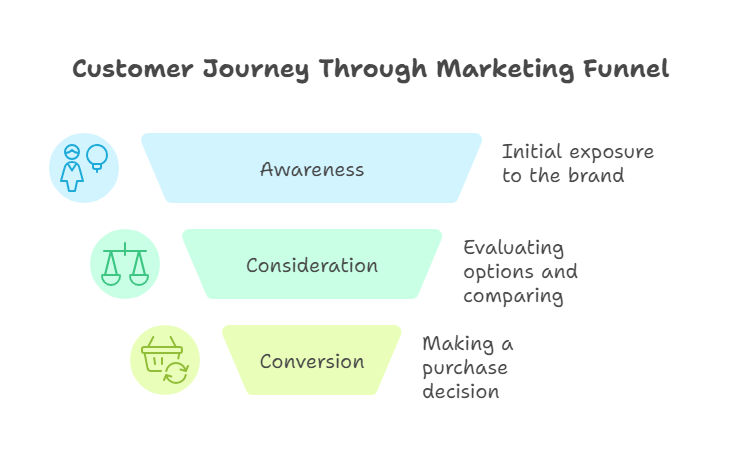
The beauty of funnel thinking is efficiency. Instead of hoping random people will buy your product, you systematically guide interested prospects through each stage, minimizing wasted effort and maximizing results.
We’ll focus on a simple three-stage model that maps to what marketers call TOFU (Top of Funnel), MOFU (Middle of Funnel), and BOFU (Bottom of Funnel):
- Awareness (TOFU): “I didn’t know this existed”
- Consideration (MOFU): “This might solve my problem”
- Conversion (BOFU): “I’m ready to buy”
Stage 1: Awareness (Top of Funnel)
Purpose: Make people aware of your brand or the problem you solve.
This is where people first interact with your brand. It’s your handshake, your introduction to the world. In today’s world of massive distraction, what you say here and how relevant you are to your audience matters enormously.
Digital Channels for Top Funnel:
- Video content (Instagram Reels, YouTube Shorts, TikTok)
- Blog posts addressing common problems
- Display advertising
- Programmatic advertising
- Social media content
- Influencer partnerships
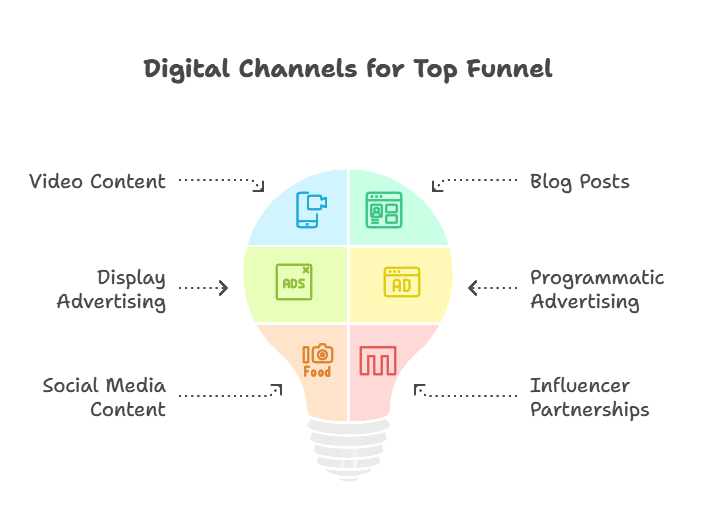
Video is generally regarded as the best method in 2025 for quick awareness through “thumb-stopping” content. A well-crafted blog post explaining a problem someone might have can also be a great introduction. If someone searches “how to get rid of back pain” and you’re a physiotherapist with solutions, they can discover you through your content.
Key Metrics to Track:
- Reach: How many unique people saw your content
- Impressions: Total number of times your content was displayed
- Frequency:
- Views: For video content, how many people watched
- Brand Mention Volume: How often your brand is discussed online
Example: Zomato(Now Eternal Ltd) built massive awareness in India through humor and relatable content about food culture, creating thumb-stopping social media posts that addressed universal experiences like “waiting for food delivery.”
Common Mistake: Expecting immediate purchases from awareness content. This stage is about introduction, not conversion.
Stage 2: Consideration (Middle of Funnel) Purpose: Educate, nurture, and qualify potential customers.
Being aware of your brand isn’t enough to create customers. You need to nurture these prospects and guide them toward your solutions.
Here’s the thing about middle funnel thinking: Someone renovating their home isn’t actively searching “buy refrigerator” yet, but they’re displaying behavior that shows they’re in the market—browsing home renovation blogs, researching flooring materials, reading kitchen design guides. This is your window to show them your state-of-the-art refrigerators before they enter active shopping mode.
Think of this as the “coffee meetup” stage in our dating analogy—you’re not in a relationship yet, but you’ve begun the consideration process.
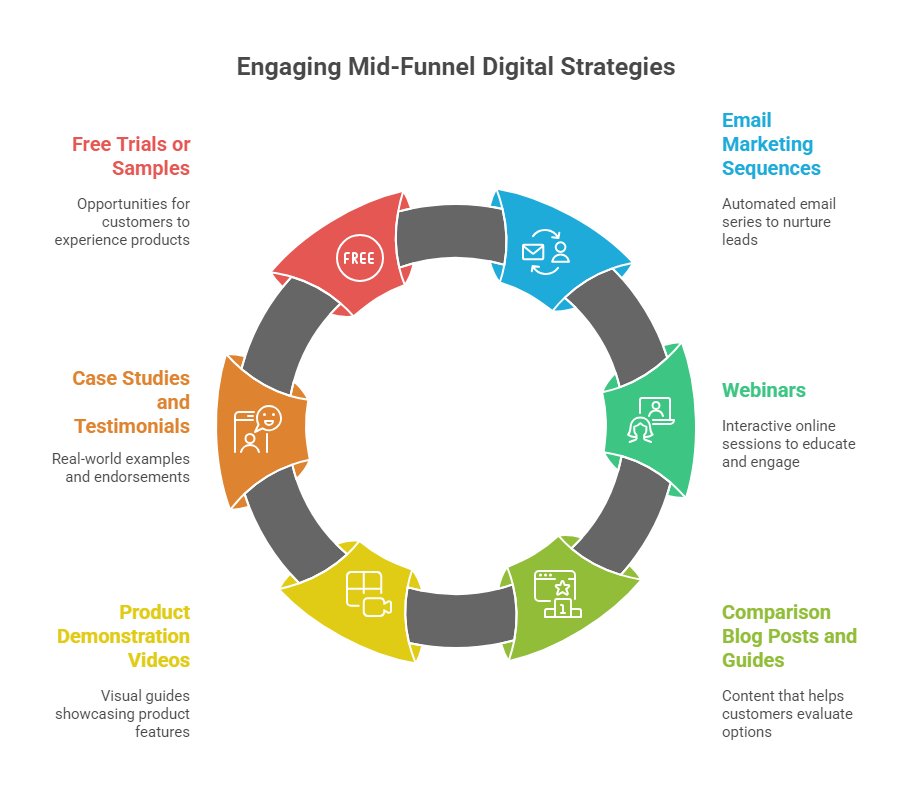
Digital Channels for Mid Funnel:
- Email marketing sequences
- Webinars
- Comparison blog posts and guides
- Product demonstration videos
- Case studies and testimonials
- Free trials or samples
Key Metrics to Track:
- Click-Through Rate (CTR): Shows deeper engagement beyond just viewing
- Time on Page: How long people spend consuming your content
- Email Open and Click Rates: Engagement with nurturing content
- Lead Generation: Email signups, download requests, demo bookings
- Video Completion Rate: How much of your educational content people watch
Example: HubSpot excels at consideration-stage content by offering free marketing templates, guides, and courses in exchange for email addresses, then nurturing these leads with valuable educational content.
Common Mistake: Using the same creative and messaging from awareness stage. Consideration content should be more detailed and solution-focused.
Stage 3: Conversion (Bottom of Funnel)
Purpose: Turn intent into action—purchase, sign-up, or inquiry.
This is the showdown where you turn nurtured conversations into action. All your communication and design should guide users toward taking a specific action, whether it’s a purchase, signup, or enquiry.
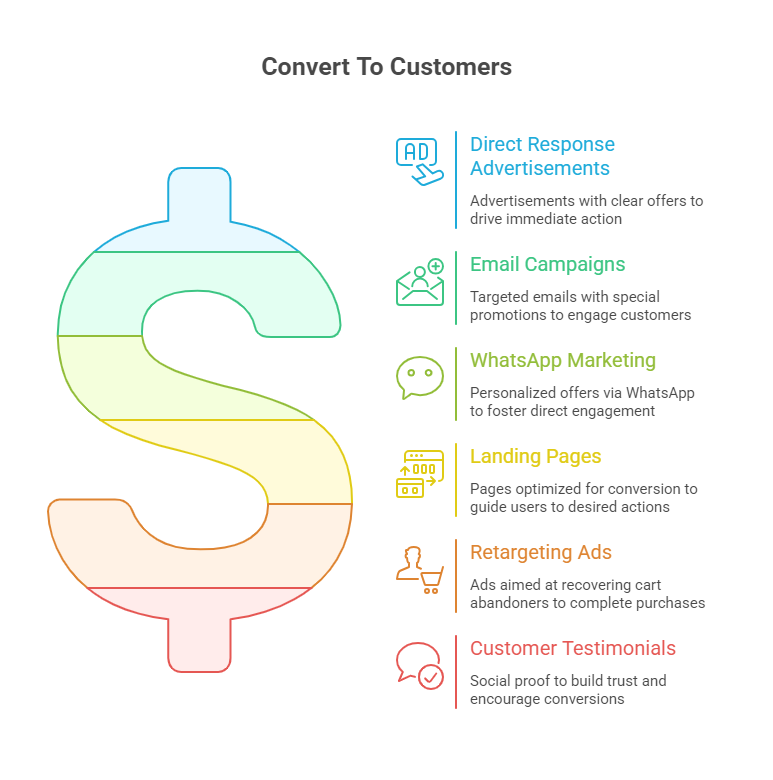
Digital Channels for Bottom Funnel:
- Direct response advertisements with clear offers
- Email campaigns with special promotions
- WhatsApp marketing for personalized offers
- Landing pages optimized for conversion
- Retargeting ads for cart abandoners
- Customer testimonials and social proof
Key Metrics to Track:
- Conversion Rate: Percentage of visitors who complete your desired action
- Cost Per Acquisition (CPA): How much you spend to acquire each customer
- Return on Ad Spend (ROAS): Revenue generated per dollar spent
- Cart Abandonment Rate: For e-commerce businesses
- Lead-to-Sale Conversion Rate: For service businesses
Example: Amazon’s one-click purchasing, urgency indicators (“Only 3 left in stock”), and personalized recommendations all work together to convert consideration into purchases.
Common Mistake: Going straight to conversion messaging without building awareness and consideration first. This dramatically lowers efficiency and increases costs.
Modern Funnels: Why They’re Not Linear
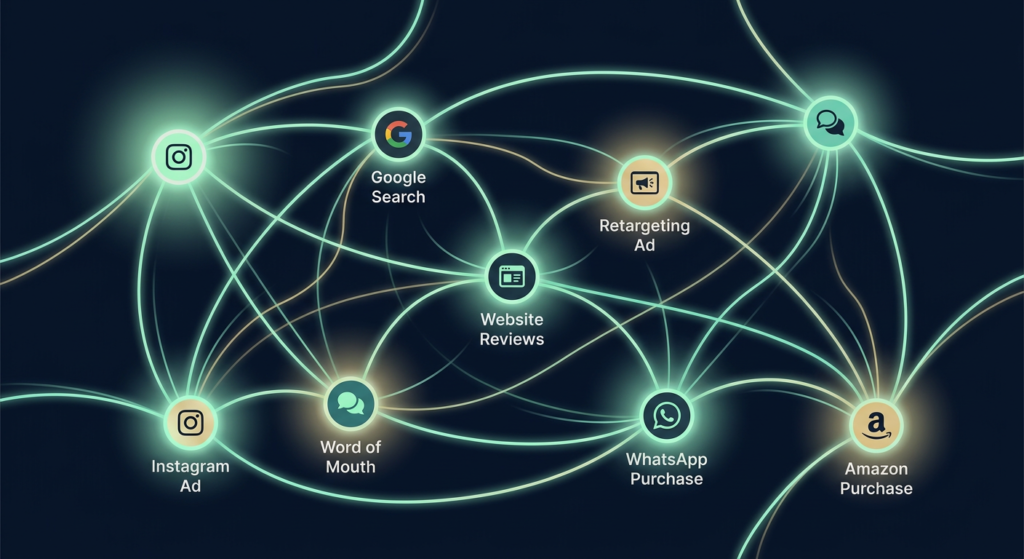
While understanding funnel stages is crucial, modern customer journeys don’t follow a straight path. Instead, they’re more like a web of interconnected touchpoints.
A typical customer journey might look like:
- Sees your Instagram ad (Awareness)
- Googles your brand name (Consideration)
- Reads reviews on your website (Consideration)
- Sees a retargeting ad with an offer (Conversion)
- Discusses with friends or family (Consideration)
- Finally purchases through WhatsApp or Amazon (Conversion)
This is the omnichannel reality-where customers might discover brands on social media, does research on Google, and complete purchases through WhatsApp or offline stores.
Understanding funnel stages helps you create the right message for each touchpoint, even when customers jump between stages.
Metrics That Matter at Each Stage
| Stage | Goal | Key Metrics | Example Channels |
| Awareness | Get noticed | Reach, Impressions, Views, Brand Mentions | Blog posts, Video content, Display ads |
| Consideration | Build interest | CTR, Time on Page, Leads, Email Engagement | Retargeting ads, Email sequences, Comparison guides |
| Conversion | Drive action | Conversion Rate, CPA, ROAS, Revenue | Offer pages, WhatsApp campaigns, Direct response ads |
Common Funnel Mistakes That Kill Results
1. Using Wrong KPIs for Each Stage
Many marketers judge upper-funnel ads by conversion metrics while measuring lower-funnel ads by vanity metrics like website traffic. This misalignment leads to inefficient spending and poor decision-making.
Solution: Match your metrics to your funnel stage objectives.
2. Expecting Purchases from Cold Traffic
Showing conversion-focused ads to people who’ve never heard of your brand results in poor conversion rates and wasted budget.
Solution: Build awareness and consideration before pushing for conversions.
3. Using Same Creative Across All Stages
The same message that introduces your brand won’t effectively convert someone ready to buy.
Solution: Develop stage-specific creative and messaging strategies.
4. Skipping the Middle Funnel Entirely
Many advertisers run only awareness and conversion campaigns, missing the crucial nurturing stage where trust and authority are built.
Solution: Invest in consideration-stage content and retargeting campaigns.
Why Funnel Thinking Changes Everything
Strategic Budget Allocation
Funnel thinking helps you allocate budget strategically across awareness, consideration, and conversion activities. You can measure performance at each stage and identify where prospects drop off.
Clearer Creative Direction
Understanding funnel stages helps you create the right communication for the right user. Someone researching “window vs split air conditioner” needs different content than someone ready to buy with a 50% discount offer.
Purpose-Driven Metrics
Every metric becomes meaningful when viewed through the funnel lens. You understand what each number represents in the customer journey and can take appropriate action.
Better Campaign Planning
Funnel logic helps explain marketing strategy to stakeholders and founders by showing how each campaign contributes to the overall customer acquisition process.
Putting It All Together
Effective marketing isn’t about shouting the loudest or bombarding users, It’s about guiding the right person, step by step, toward a decision.
Remember, funnel thinking simplifies complex buyer journeys into a digestible process. When you understand where your prospects are in their journey, you can provide exactly what they need to move forward.
What’s Next?
Now that you understand metrics and funnel stages, the next crucial piece is knowing which audiences to target and understanding key psychological triggers that influence buying decisions.
In our next article, we’ll dive deep into “Audience Targeting & Buyer Psychology”—exploring how to identify your ideal customers and what motivates them to make purchasing decisions.